

Trend Analysis: types, methods and examples
Trend analysis is the process of examining data patterns over time to predict future business outcomes and make proactive decisions.
Traditional reporting tells you what happened last quarter.
Trend analysis reveals:
- Why it happened
- Whether it will continue
- What you should do about it
For operations leaders running multiple locations or complex functions, market trend analysis is the difference between reacting to problems after they cost you revenue and spotting opportunities before competitors know they exist.
Think of it as your early warning system and opportunity radar in one.
Research from McKinsey shows that B2B companies that effectively use commercial analytics are 1.5 times more likely to post above-average growth than competitors.
Yet most operations leaders still lean on gut instinct or backward-looking reports that say what happened without explaining why or what comes next.
The rest are flying blind, making gut-call decisions based on the most recent report or the loudest voice in the room.
We have seen this pattern repeatedly
A manufacturer notices declining sales in March. By the time leadership investigates, finds the cause, and implements changes, it is June.
They have lost an entire quarter.
A competitor running trend analysis spotted the same pattern emerging in January, adjusted, and captured the share the first company lost.
That is the difference between reacting and leading.
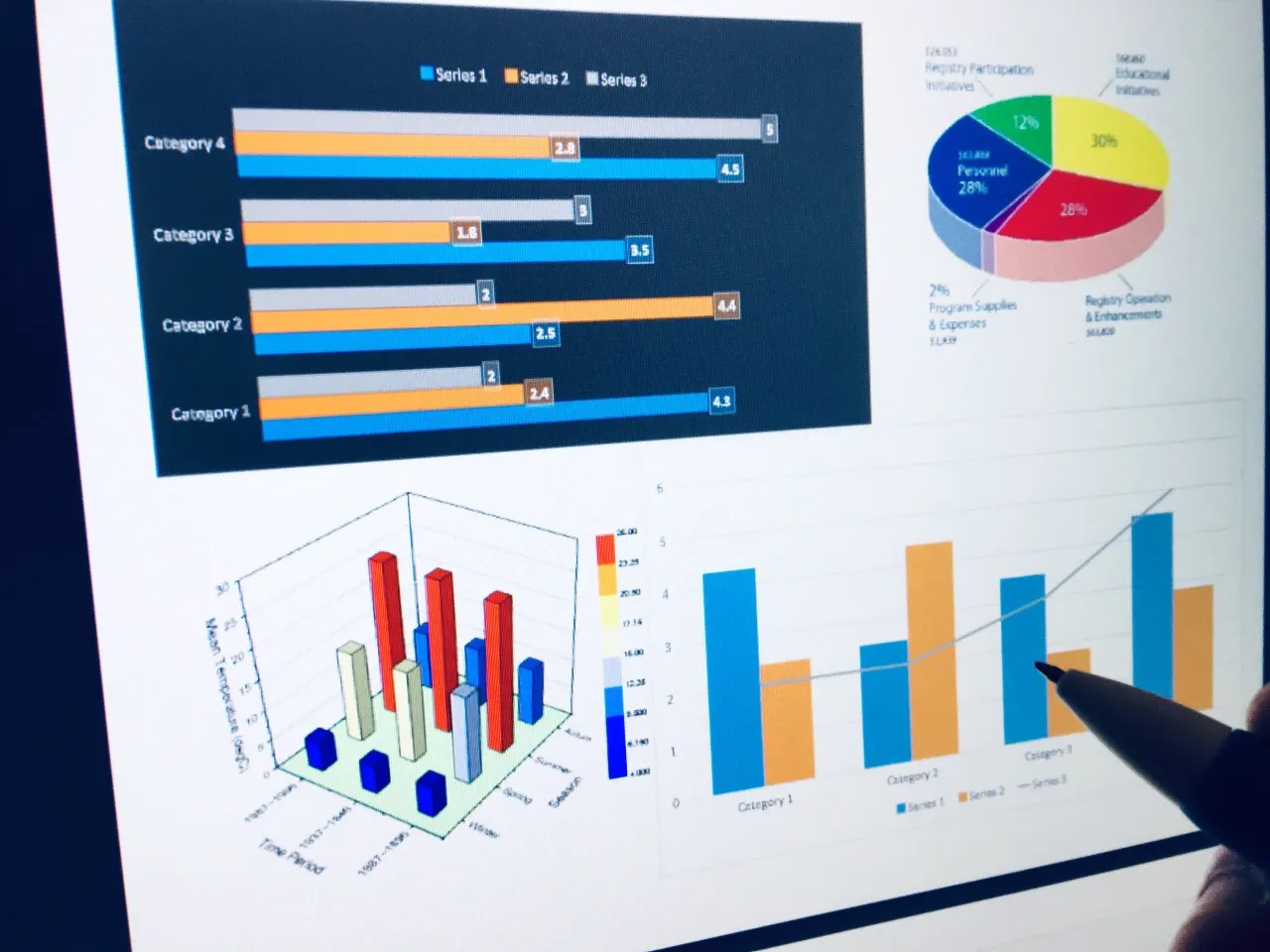
What is trend analysis?
Trend analysis is a disciplined approach to three questions.
It is also the foundation of broader data analysis work that turns raw history into decisions.
- What patterns exist in our data over time?
- What is causing those patterns?
- What do they tell us about the future?
A useful way to picture it: a single data point, like your current Monthly Recurring Revenue, is a photograph. It tells you where you stand right now. It is accurate, but static. Trend analysis is the story. It strings those frames together to show motion.
- Are you moving fast?
- Slowing down?
- About to hit a wall?
You collect data. You clean it. You examine it for consistent behaviors.
Then you use those insights to forecast what is likely next, and adjust operations accordingly.
Three operational goals emerge when you ask what trend analysis is really trying to achieve:
Identify consumer behavior
Are customers buying faster?
Downgrading subscriptions more often?
Detect operational anomalies
Is time-to-close for sales deals creeping up in a specific region?
Forecast future performance
Based on the last six months of slope, where do we land in Q4?
Other operational goals:
- Revenue trends.
- Customer satisfaction trends.
- Supply chain efficiency.
- Employee retention.
- Competitive positioning.
- Market demand.
Every data point that changes over time contains a story, and trend analysis helps you read it.
It works across nearly every part of the business.
AI Retail Analytics for Retail Chains
Find store problems before they hit the P&L.
Scoop brings AI retail analytics to retail chains by capturing how your best operators investigate performance, then running that diagnostic logic across every location, every week.
- Retail analytics at scale
- 10 hypotheses in parallel
- Executive-ready reports
The multi-scale reality of business trends
One nuance most operations leaders miss:
Trends exist at different time scales at once.
You might have:
- Short-term trends (days to weeks): Daily fluctuations, weekly cycles.
- Intermediate trends (months): Seasonal patterns, quarterly shifts.
- Long-term trends (years): Strategic direction, market evolution.
Knowing which time scale matters for your question is as important as the analysis.
This is exactly why time series analysis is important for business trends analysis, because it separates the scales instead of blending them.
The three types of trends you will encounter
Not all trends behave the same way.
Knowing the difference helps you respond correctly.
Upward trends
Upward trends show growth or increase over time.
- Maybe customer acquisition costs are rising.
- Maybe product adoption is accelerating.
- Maybe defect rates are climbing.
An upward trend is not inherently good or bad.
It depends on what you measure.
A caution: upward trends can hide rot. Revenue might trend up while churn also trends up, which means you are filling a leaky bucket.
Downward trends
Downward trends show decline or decrease.
- Customer retention dropping.
- Production efficiency improving.
- Time-to-market shrinking.
Context matters here too.
If you are measuring cost to serve or attrition, a downward trend is a win.
Horizontal trends
Horizontal trends reveal stability, values that stay consistent with no significant rise or fall.
- Sometimes stability is what you want.
- Sometimes it means you are stagnating while competitors innovate.
In a high-growth environment, flat is the new down.
If your competitors grow exponentially and you trend horizontally, you lose market share every single day.

Why market trend analysis matters more than ever
The business environment is not just changing.
It is accelerating.
- Consumer preferences that used to shift over years now move in months.
- Cutting-edge technology becomes table stakes overnight.
- Competitors arrive from unexpected directions.
In that environment, reactive operations management is a losing strategy.
A major reason leaders fall into reactive mode is Linearity Bias, the human tendency to assume lines keep going straight.
If sales rose last month, we assume they rise next month.
But business is rarely linear. It is seasonal. It is cyclical. It is chaotic.
Consider Customer Acquisition Cost
- Without trend analysis you see CAC is $500 and think it is within budget.
- With trend analysis you see CAC was $350 in January, $400 in February, $450 in March, and you realize efficiency is collapsing. By June you are unprofitable.
The difference between a static number and a trend line is the difference between driving with your eyes open and watching only the clock.
Predictive analytics extends that trend line into a forecast you can plan against.
What happens when you skip trend analysis:
You miss early warning signs
A 3% monthly decline in engagement seems trivial until you realize it has run for eight months and you have lost 24% of active users.
An example:
SMB churn looks stable at 2% monthly globally. A human analyst sees nothing wrong. A deep diagnostic reveals LATAM trending sharply down since a billing gateway outage in Brazil.
The cost of inaction is losing the region before you know there is a problem.
You misallocate resources
Without demand trends, you overstock products that are not selling and run out of what customers actually want.
You waste planning time
Your annual strategy session fixates on last year's challenges instead of next year's opportunities.
You let competitors define the market
They spot the shift toward sustainability or mobile-first experiences while you optimize the old paradigm.
Strong retail analytics exists to close exactly that gap before it shows up in the P&L.
Hotel Management Company Analytics
Stop sending reports that only show the numbers.
Scoop investigates every property, connects PMS and financial data, and turns hospitality analytics into clear narratives for owners, GMs, regional VPs, and portfolio leaders.
- Property-level diagnosis
- USALI-aware analysis
- Owner-ready reports
What trend analysis reveals that standard reports miss
Standard business reports answer what happened.
Trend analysis answers why it happened, and what happens next.
Your quarterly sales report shows revenue declined 8%. Useful, but incomplete.
- What caused the decline?
- Is it accelerating or stabilizing?
- Which segments are affected?
- Are competitors seeing the same pattern?
- Is this temporary or the start of a longer slide?
It also helps to separate trend analysis from variance analysis, two tools leaders conflate:
- Variance analysis compares Actual versus Planned at a single point in time. It tells you that you missed Q3 revenue by $50K.
- Trend analysis compares Actual versus Historical over multiple periods. It tells you revenue has decelerated 2% every month for three quarters.
Variance identifies the gap. Trend identifies the trajectory.
Effective operations leaders use both.
Market trend analysis digs deeper
- It examines multiple variables at once.
- It looks for correlation and causation.
- It compares performance against benchmarks and history.
Most importantly, it buys you time to respond strategically rather than react.
The problem of traditional reporting
Dashboards and BI tools show revenue is down, but not that it is down because a 2022 customer cohort is churning faster after a pricing change.
Closing that gap, from data point to action, is the real purpose of trend analysis.

The ten types of trend analysis every operations leader should track
Different questions call for different types of trend analysis.
Here is the roadmap to the approaches that matter most.
1. Consumer trend analysis
This examines how customers behave, think, and buy in your market.
- What are they buying?
- How has their consideration process changed?
- What influences decisions?
Practical application
A software company saw trial-to-paid conversion drop from 18% to 12% over six months. The trend revealed users who did not finish onboarding within 48 hours had a 94% chance of churning. An automated onboarding sequence recovered the rate within two quarters.
2. Competitor trend analysis
Tracking how competitors perform over time shows what resonates with your shared market and where vulnerabilities sit.
A disciplined retail strategy depends on watching competitor moves as closely as your own numbers.
Practical application
- When a competitor launches a product or campaign, how does their share move?
- If they gain, what is driving it?
- If they lose customers, where do those customers go?
3. Historical trend analysis
Past patterns give context for future events.
The flavored water market more than doubled in a decade, and that trajectory helps predict expansion and time market entry.
Historical data analysis is what makes those long arcs visible in the first place.
Practical application
A manufacturer analyzed five years of production data and found defect rates spiked 6 to 8 weeks after hiring surges. Enhanced training protocols cut defects 40% during growth periods.
4. Temporal trend analysis
Comparing specific time periods helps you understand:
- Seasonality
- Cyclical patterns
- Time-based anomalies
Practical application
An e-commerce business compared quarter-over-quarter trends and found Q1 marketing spend delivered 3x better ROI than Q3, despite Q3 getting larger budgets. Reallocating raised annual customer acquisition 28%.
5. Geographic trend analysis
Regional differences often reveal opportunities or risks that aggregate data hides.
Practical application
A restaurant chain's national sales looked stable, but geographic analysis showed West Coast locations growing 15% annually while Midwest declined 8%. That prompted region-specific menu and marketing changes.

6. Demographic trend analysis
Understanding how segments evolve helps you tailor your approach.
The discipline overlaps heavily with customer segmentation, which groups buyers by shared traits and behavior.
Practical application
A B2B software company found its fastest-growing segment was companies with 50 to 200 employees, not the enterprise clients it had targeted. It adjusted the:
- Roadmap
- Pricing
- Sales strategy
All to capture the high-growth segment.
7. Economic trend analysis
- Inflation
- Recession
- Spending power
These external forces hit your operations whether you track them or not.
Practical application
During inflationary periods, understanding how customer purchasing power changes lets you adjust pricing, build value tiers, or modify offerings before demand drops.
8. Technological trend analysis
Technology evolves continuously.
The question is not whether new technology will affect your business, but when and how.
Practical application
A logistics company tracked the autonomous-vehicle development curve and started pilots three years before competitors, earning first-mover advantage in automation.
9. Sentiment trend analysis
With modern natural language processing tools, you can analyze unstructured data to track how attitudes and emotions shift over time.
This turns qualitative signals into quantitative early warnings.
Customer signals
Analyzing support-ticket language showed the phrase login error appeared in 40% more tickets in one week than the previous week.
That qualitative trend predicted churn weeks before retention metrics moved.
Employee sentiment
A distribution center ran monthly safety pulse surveys.
Sentiment analysis showed I feel comfortable reporting safety concerns dropping from 78% to 61% over six months, an early warning that prevented a serious incident.
10. Milestone trend analysis
Milestone trend analysis (MTA) is a project-management technique that monitors scheduled milestone dates over time.
It plots the estimated completion date against the reporting date to show whether deadlines are slipping, holding, or pulling forward.
If you run Professional Services, an onboarding team, or any complex initiative, MTA is your best friend.
How MTA works
Say a project is due June 1.
- Report 1 (January): delivery June 1.
- Report 2 (February): June 5.
- Report 3 (March): June 15.
And at the end, a standard status report just says Yellow.
An MTA chart shows the drift.
You can calculate the velocity of the delay.
Lose 5 days a month and you can predict a 20-day miss unless you intervene.
What you look for in an MTA chart:
- Horizontal lines. Stable forecasts (good sign).
- Upward-sloping lines. Dates slipping out (warning sign).
- Downward-sloping lines. Dates moving closer (efficiency gains, or descoping).
- Zigzag patterns. Unstable estimates, signaling poor planning or external volatility.
Practical application
A construction operations director used MTA on every major project. She put it plainly: she used to wait for status reports to tell her she was behind. Now she sees the trend develop 4 to 6 weeks before it becomes a crisis, and course-corrects while options remain.
Franchise Domain Intelligence
Give field ops the diagnosis before the call starts.
Scoop helps franchisors turn franchise performance analytics into pre-call briefings that explain what is happening, why it is happening, and what each franchisee should focus on next.
- Every franchisee. Every cycle.
- 15 to 30 diagnostic probes
- Pre-call action plans
How to conduct a trend analysis
Theory is nice. Implementation is what matters.
Here is the step-by-step framework operations leaders use, and a fuller walkthrough lives in our guide on how to do trend analysis.
Step 1: Define your objectives
You cannot analyze everything.
Start with clarity.
Improve customer retention is vague.
Understand why enterprise renewal rates dropped from 87% to 79% over four quarters is specific.
Your objective determines which data you collect, which methods you use, and how you read results.
Ask yourself:
- What decision will this analysis inform?
- What would count as an actionable insight?
- What outcome would justify the time invested?
Step 2: Collect relevant data
Data quality matters more than quantity.
You need history that is comprehensive, accurate, relevant, and structured.
Sources include your:
- CRM
- Financial statements
- Production databases
- Surveys
- Web analytics
- Sales records
- Industry reports
One medical device manufacturer found incomplete data was worse than no data. They tracked returns but did not record reason codes consistently. Their trend showed return rates rising, but they could not find causes until they fixed collection.
Step 3: Clean and prepare your data
Raw data is messy.
Before analysis, remove duplicates, fill missing values, standardize formats, flag outliers, and normalize measurements.
Not glamorous, but essential. Garbage in, garbage out.
A practical tip:
Bin your data before visualizing.
Do not look at every transaction.
Group by week or month, and filter obvious outliers like test accounts or zero-value transactions first.
A clean trend needs a clean source.
Step 4: Visualize your data
Numbers in spreadsheet rows hide patterns that charts reveal instantly.
Build visual representations:
- Line graphs for trends over time
- Bar charts for category comparisons
- Scatter plots for correlation
- Heatmaps for multi-variable patterns
- MTA charts for project tracking
Here is a truth most people resist:
If you cannot visualize the trend clearly, you do not understand it yet.
Picking the right chart type is half the battle.

Step 5: Choose your analysis method
Different questions need different approaches:
Moving averages
It smooth short-term noise to reveal longer trends.
A 3-month or 6-month moving average shows the real direction beneath variation.
Regression analysis
It establishes relationships between variables.
Does marketing spend correlate with revenue growth? Regression quantifies it.
Time series analysis
It examines data collected at intervals to find:
- Patterns
- Cycles
- Seasonal effects
Comparative analysis
It evaluates how groups perform.
- This quarter versus last quarter.
- Your company versus competitors.
Linear trend analysis
It assumes a steady rate of change. The formula is:
This is useful for consistent revenue growth or steady customer expansion.
Non-linear trend analysis
It matters when growth accelerates or decelerates, like exponential viral adoption or S-curve technology rollouts.
Cyclical trend analysis
It looks for patterns that repeat off the calendar, like economic or inventory cycles.
The method matters less than matching it to your question.
Step 6: Identify key metrics
Not every data point deserves equal attention.
Focus on metrics that drive your objective, that you can influence, that give early warning, and that quantify outcomes. Choose 5 to 10 maximum.
Well-built KPI dashboards keep that short list front and center.
Step 7: Segment and analyze subgroups
Aggregate data hides detail.
If overall satisfaction is stable at 7.2/10, that seems fine, until you segment by tenure and find satisfaction among customers in months 3 to 6 dropped to 5.8/10.
Always segment customers by:
- Demographics
- Region
- Product line
- Period
- Channel
- Lifetime-value tier
Each segment may show a different trend needing a different response.
Step 8: Validate your findings
Before you act, validate.
Statistical testing confirms whether a trend is significant or random.
A 5% change may look meaningful but sit within normal fluctuation.
Cross-validation checks findings against other sources or periods.
Peer review brings fresh eyes.
Step 9: Interpret and document
Translation matters.
Your analysis must answer:
- What the trend is
- What is causing it
- What it means
- What you should do
Document everything.
Three months out, you will want your:
- Methodology
- Assumptions
- Reasoning
Step 10: Communicate and act
Analysis without action is expensive busywork.
Present findings with an executive summary in 3 to 4 sentences, visual evidence of the trend, the business impact in revenue or risk terms, recommended actions with expected outcomes, and a timeline.
The best trend analysis we have seen fits on two slides: one shows the trend, one shows the response.

Advanced techniques that deliver deeper insights
Once the basics are solid, these methods reveal patterns simple analysis misses.
Moving averages for noise reduction
- Simple Moving Average (SMA) is the arithmetic mean over a set number of periods.
- Exponential Moving Average (EMA) weights recent data more heavily, making it more responsive to current change.
Both help you see the signal beneath the noise.
Daily revenue may swing wildly while a 30-day moving average reveals the underlying trend.
Regression analysis for predictive power
Regression establishes mathematical relationships between variables.
Linear regression fits a trend line using:
If revenue grew an average of $50,000 per quarter for three years, regression helps forecast next quarter and flags when actuals deviate.
It also answers whether X causes Y.
Does adding support staff actually cut churn?
A predictive model built on that relationship can save a fortune in misdirected spend.
Seasonal decomposition for complex patterns
Many metrics contain overlapping patterns:
- A trend component
- A seasonal component
- A residual
Seasonal Decomposition of Time Series (STL) separates these so you can tell structural change from normal seasonal variation.
Process mining
Understanding how trends happen
Traditional trend analysis tells you where you are, not how you got there.
You see churn rose from 3% to 5%.
But what process led there?
Process mining analyzes event logs to understand actual workflows, not theoretical ones.
Combined with trend analysis, you can ask which sequence of events predicts deal closure, how it has changed, and where deals get stuck.
Practical application
A SaaS company tracked support resolution time and saw a stable 2.3-day average. Process mining revealed the real pattern: 60% of tickets resolved under 4 hours, 25% in 1 to 2 days, and 15% stuck for 7+ days. The stable average hid a bimodal distribution where 15% of customers got terrible service. Tickets escalated to Level 2 were entering a black hole.

Real-world trend analysis examples
Here is how this works in practice.
Example 1: The multi-location operations challenge
The situation
EZ Corp operates 1,279 pawn locations nationwide. Their COO could manually review maybe 20% of stores daily, meaning 80% of potential issues went unnoticed until they turned critical.
The traditional approach
Monthly reports showing aggregate performance by region.
Problems found weeks after they started. Reactive management.
The transformation
Rather than describe this as encoding abstract expertise, picture how the capture actually worked. As Scoop founder Brad Peters describes the setup, the team followed around with the tape recorder and tracked what they were doing. They sat with the senior managers and recorded their entire process of how they think about looking at the information, capturing seven hours of recordings on how they interpret the Power BI during an 11-store field tour. That interpretation logic was encoded into an investigative system that runs across all 1,279 locations at once.
When Store 523's P&L showed a 25% decline, traditional BI would flag it as a problem needing investigation. That is where most systems stop. The system kept going: it investigated customer segments across 196 data columns, found a 35% drop in the 25 to 34 demographic, analyzed redemption patterns and category mix, discovered nearby stores 541 to 543 had offset capacity, and recommended specific actions based on what worked at similar stores. Electronics performance was degrading at Stores 412, 589, and 721 at the same time, a broader pattern invisible in traditional reporting.
The result
Accuracy climbed from 70% to 95%+ as the system learned the business's specific terminology and patterns.
Complete visibility across all operations with executive-level analysis quality.
Example 2: The e-commerce retention mystery
The situation
An online retailer saw retention decline from 68% to 61% over eight months.
Segmenting by acquisition channel, order value, category, and tenure revealed retention dropped only among customers from paid social.
Those customers had 40% lower satisfaction scores.
The root cause: marketing optimized for cost-per-acquisition without weighing customer quality. This is a classic churn analysis finding.
The result
They adjusted targeting, raised acquisition costs 12%, and improved customer lifetime value 34%.
Example 3: The SaaS expansion opportunity
The situation
A B2B software company was deciding where to invest product development.
Segmenting by company size, industry, and usage over 24 months revealed companies with 50 to 200 employees growing 43% year over year versus 8% market growth.
That segment valued specific features enterprise clients rarely used.
The result
They built a mid-market tier, adjusted pricing, and captured 28% additional share in 18 months.
Example 4: Revenue operations, finding the real bottleneck
Sales Cycle Length trended from 45 to 60 days over two quarters.
The instinctive response is to pressure sales.
But trend analysis at the stage level showed the delay was concentrated in Legal Review. The trend exposed a bottleneck in Legal, not Sales.
No amount of sales coaching fixes a legal-process problem. This is the kind of insight a strong RevOps strategy is built to surface.
Example 5: The billing bug discovery
When trend analysis ran on a client's invoice data, the revenue trend line looked off for the MidMarket segment.
A human eye might have missed it, but a deeper engine flagged that:
amount_due was consistently 20% lower than base_price multiplied by seats.
It was not a sales slump. It was a billing bug undercharging clients.
Trend analysis caught what the code missed and recovered revenue that had leaked silently for months. Catching that early is the heart of anomaly detection.
The evolution from manual to autonomous trend analysis
Modern trend analysis platforms automate the heavy lifting.
- They connect to all your sources
- Clean and prepare data with intelligent algorithms
- Run multiple methods at once
- Test numerous hypotheses in parallel
- Find patterns across hundreds of variables
- Deliver insights in hours
More importantly, they investigate on their own.
You do not have to know what question to ask.
The platform recognizes when patterns deviate and investigates why.
This is the shift from traditional BI to Domain Intelligence.
The time savings are dramatic.
But the real value is not speed. It is coverage.
You cannot manually investigate everything, so you miss things.
Autonomous trend analysis investigates comprehensively.
Domain Intelligence
Give AI the context your best people already know.
Scoop captures operator judgment, screens every location, and turns hidden signals into governed investigations, clear findings, and action plans your team can trust.
- Context-aware analysis
- Autonomous investigation
- Executive-ready reports
Common trend analysis mistakes and how to avoid them
Even experienced operations leaders make these errors.
Mistake 1: Confusing correlation with causation
Ice cream sales and drowning deaths both rise in summer.
Ice cream does not cause drowning.
Warm weather drives both.
Always ask what else could explain the pattern, and test multiple hypotheses before concluding cause and effect.
This is where multi-hypothesis investigation matters:
Instead of latching onto the first plausible explanation, test 10 to 15 possibilities and rank them by statistical strength.
Mistake 2: Ignoring external factors
Your sales declined 15% last quarter.
- Is it your product?
- Is it marketing?
- Is pricing?
- Is the whole industry contracting?
Always compare internal trends against benchmarks and economic indicators.
A manufacturer whose efficiency trends improved in Q2 later found the cause was a competitor's factory fire reducing supply, not their own gains.
Mistake 3: Using insufficient time periods
Three months of data rarely reveals a meaningful trend.
Use at least 12 to 18 months for annual patterns, 3 to 5 years for strategic trends.
Be especially wary of confusing seasonality with a negative trend.
Panic hits in January when B2B sales drop 40% from December.
Overlay the previous three years and you may see January always drops 40%.
Use year-over-year comparisons for seasonal businesses.
Mistake 4: Failing to validate findings
One anomaly can create the appearance of a trend that does not exist.
Cross-check across sources.
If your CRM shows a trend, does it appear in:
- Financial data?
- Surveys?
- Support tickets?
Mistake 5: Analysis paralysis
Spending months perfecting analysis while conditions change and opportunities vanish.
Better to have directionally correct insights in two weeks than perfect analysis in three months.
We have seen companies build the perfect model and miss the entire window to act.
Mistake 6: Treating all trends equally
Not every trend deserves attention.
The biggest advantage of intelligent analytics platforms is prioritization.
They do not just surface 1,000 trends.
They highlight the 7 that matter most by:
- Business impact
- Confidence
- Urgency
Manual analysis treats all patterns equally.
Smart analysis focuses limited attention on high-impact threats and opportunities.

How to choose the right trend analysis approach for your business
Not every business needs the same sophistication. Match the approach to your situation, and compare it against how augmented analytics changes the math at scale.
| Scale | Recommended approach | Investment | When to upgrade |
|---|---|---|---|
| Small businessUnder 50 employees | Spreadsheet analysis (Excel or Google Sheets). Focus on 3 to 5 key metrics tracked monthly. | Time plus free tools | When manual analysis takes more than 4 hours per week. |
| Mid-market50 to 500 employees | BI platforms with built-in trend analysis. Department-level trends, weekly or monthly. | $5K to $50K per year | When you need faster insights or have multiple segments to track. |
| Multi-location100+ locations | Autonomous investigation Automated trend analysis with location-level daily monitoring. |
Operational-scale platforms | When manual analysis becomes impossible and autonomy is essential. |
| Enterprise1,000+ employees | Comprehensive analytics with advanced ML. Real-time detection across all functions. | High personnel plus platform | When the cost of missed trends justifies substantial investment. |
Three implementation paths exist in practice:
Manual spreadsheet analysis
Best for 1 to 5 locations and 5 to 10 KPIs.
Investment: your time, 10 to 20 hours weekly.
Builds statistical thinking, but does not scale and limits you to metrics you think to analyze.
Traditional BI platforms
Best for 5 to 50 locations and 10 to 50 KPIs.
Professional visualizations and standardized reporting, but still requires manual investigation and does not learn your business context.
Domain Intelligence platforms
Best for 50+ locations or high metric volume.
- Automated investigation
- Learns your business
- Explains findings in plain language
- Scales
- Catches patterns humans miss
Scoop's team handles the hands-on setup, so the platform is not something you configure yourself.
Multifamily Portfolio Analytics
Screen every property. Act before the owner calls.
Scoop turns property management analytics into written portfolio intelligence, helping your team identify retention risk, maintenance patterns, expense anomalies, and NOI erosion across every building.
- Rent roll intelligence
- Maintenance pattern detection
- Regional and portfolio rollups
The role of AI and machine learning in modern trend analysis
Traditional statistical methods work, but they have limits:
- They are reactive. You have to decide what to analyze.
- They are single-threaded. They test one hypothesis at a time.
- They require expertise. You need to know which test to apply.
- They are time-consuming. Manual analysis does not scale.
This is where AI and machine learning change trend analysis.
Pattern recognition at scale
ML algorithms examine thousands of variables at once, finding correlations humans would never spot.
A manufacturer discovered through ML-powered analysis that defect rates correlated with a specific supplier's delivery schedule, a connection across 15 months no human analyst had considered.
Automated data preparation
Modern AI handles the tedious work of:
- Cleaning
- Normalizing
- Structuring data
What used to take hours happens automatically.
Explainable machine learning
The challenge with many ML approaches is the black-box problem.
They generate predictions without explaining reasoning, which is useless for business decisions.
A specific warning:
Many AI tools use Large Language Models to guess at trends.
LLMs are text predictors, not calculators.
Ask them to spot a trend in raw numbers and they often hallucinate patterns that are not there.
The fix is a neurosymbolic architecture that separates the brain from the mouth.
If your AI cannot show you the math behind the trend, do not trust the trend.
Continuous learning
The most powerful systems learn from usage.
When you flag whether an insight was valuable, the system refines its understanding of your business.
Advanced applications: what becomes possible
Predictive churn modeling
A B2B SaaS company combined MTA with behavior trends to predict churn with 89% accuracy 45 days before customers left.
The key was the trend of trends:
Customers whose engagement declined at an accelerating rate were almost certain to churn.
Cross-location pattern recognition
A retail chain with 127 locations used comparative analysis to identify pattern clusters:
- 23 locations showing urban decline
- 34 showing suburban growth
- 18 showing market saturation
Each cluster needed a different strategic response.
Predictive equipment maintenance
A manufacturer analyzed:
- Vibration
- Temperature
- Cycle time
- Energy across all equipment
ML identified degradation signatures predicting failure 60 to 90 days out.
First-year results:
Three major failures prevented, $4.7 million saved, zero unplanned downtime.

Frequently asked questions
How often should I conduct trend analysis?
It depends on how fast your environment changes and how volatile each metric is. Cash flow warrants weekly monitoring. Sales pipeline: weekly or bi-weekly. Employee sentiment: quarterly. Strategic metrics: annually. Match the update frequency to the natural cycle of what you measure. Analyzing a long-term trend like brand sentiment daily just chases noise.
- Related reading: how to perform trend analysis on a recurring cadence.
What is the difference between trend analysis and forecasting?
Trend analysis identifies and explains patterns in existing data. It is descriptive: revenue declined 8% over six months. Forecasting uses those patterns to predict future values. It is predictive: if this continues, we hit $X by year-end. Think of trend analysis as diagnosis and forecasting as prognosis. You conduct trend analysis first, then forecast. You cannot forecast accurately without understanding the historical trend.
- See our guide to predictive analytics for sales forecasting for the forecasting side.
What is the difference between trend analysis and variance analysis?
Variance analysis compares Actual versus Planned at a single point in time. Trend analysis compares Actual versus Historical over multiple periods. Variance identifies the gap: you missed Q3 by $50K. Trend identifies the trajectory: revenue has decelerated 2% every month for three quarters. Effective leaders use both, variance to judge immediate performance and trend to forecast future reality.
- More on the reporting foundation in business intelligence versus business analytics.
How much historical data do I need?
For most operational metrics, you need a minimum of 6 months of consistent data to identify meaningful trends. 12 months is better because it captures a full annual cycle. As a rule of thumb, you need at least 6 to 12 data points for a reliable business trend. Be wary of analyzing fewer than 3 points. That is not a trend, it is a coincidence. Fast-moving metrics like daily output or call volume can start showing patterns with 60 to 90 days.
- Snapshotting helps here. See time series analysis with data snapshots.
Can small businesses benefit from trend analysis?
Absolutely. You do not need massive datasets. Even 12 months of sales data, customer feedback, and operational metrics can reveal actionable trends. The methodology scales from small business to enterprise. Only the data volume and automation sophistication change.
- Start with the best AI data analysis tools for small businesses.
How do I start trend analysis with messy data?
Start by binning your data. Do not look at every transaction. Group by week or month. Filter obvious outliers like test accounts or zero-value transactions first. Ensure consistency: are you defining Lead the same way in Q1 as in Q4? Are missing values treated as zeros? A clean trend needs a clean source, which is why some teams move beyond data analysis in Excel once volume grows.
How do I know if a trend is statistically significant or just noise?
Statistical testing methods (t-tests, chi-square, confidence intervals) help determine significance. As a rule of thumb, larger samples, longer periods, and consistent patterns across segments increase confidence. If your trend line explains more than 70% of the variance (R-squared above 0.7), it is likely significant. Data points consistently outside 2 to 3 standard deviations from the mean signal a real pattern, not noise.
What if different trends contradict each other?
This happens often and is actually valuable. Overall revenue might trend up while customer satisfaction trends down, revealing growth that is unsustainable long-term. Contradictions are not problems with your analysis. They are insights about your business that highlight areas needing attention before they become critical.
Can AI automate trend analysis without hallucinating?
Yes, but only if the AI uses a neurosymbolic architecture rather than a pure LLM. Standard LLMs are text predictors, not calculators. A proper approach separates the tasks: a deterministic math engine calculates the regression and slope, then the LLM writes the summary in plain English. Never trust a trend from an AI that cannot show you the underlying math. More on this in our look at how AI enhances data analysis workflows.
Is milestone trend analysis only for project managers?
No. MTA is critical for any operations leader responsible for time-to-value or implementation cycles. RevOps leaders use it to track customer onboarding. If the Go Live date for new clients slips 5 days per cohort, that is an operational bottleneck affecting revenue recognition. MTA visualizes that slippage immediately, so you fix the process before it hurts cash flow.
What is the biggest mistake companies make with trend analysis?
Treating it as a one-time project rather than an ongoing discipline, and treating all trends equally rather than prioritizing by business impact. Market conditions evolve. Trends that were critical six months ago might be irrelevant today. The companies that benefit most make it a systematic part of operations, reviewing trends regularly and adjusting strategy accordingly.